What are the most horrible things you can imagine? Loneliness? Helplessness? Unceasing mortal fear from morning to night?
What about specifics? A human newborn baby roasting on a spit at an abandoned campsite? A cellar full of naked human livestock, some with cauterized stumps where limbs have been removed as food for their captors? A solemn promise to murder your small child -- to smash his brain with a stone -- rather than let him be captured by sodomites and cannibals?
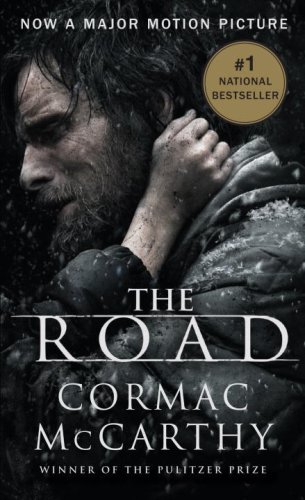
These are the essential elements of Cormac McCarthy's post-apocalyptic novel The Road, without doubt the most terrible, beautiful, miserable, punishing book I have ever read.
Because I care for my readers, I beg you to skip this book. The Road, a Pulitzer winner, has been called the best book of the last twenty-five years and the best book of the decade, but I call the reading of it masochistic. There is no levity. The anemic tendrils of hope are short-lived and emphatically dashed. Even the vast sections of tedium are laced with shivering omen.
Whatever McCarthy's grand intended message, it vanished like so much sugar in a ladleful of ipecac. This is no Diary of a Young Girl; this is exploitative horror from whole cloth masquerading as social commentary -- a literary Marilyn Manson album.
An Amazon Kindle looms large on my Christmas list this year. I know now I'd pay a hefty premium for an "Un-Read This Book" feature.
"If there must be trouble, let it be in my day, that my child may have peace."
Thomas Paine
Showing posts with label reviews. Show all posts
April 14, 2010
January 15, 2010
The Man Who Would be Blog King
Jim Treacher (né Sean Medlock) has created my new favoritest blog on the Internets. The DC Trawler is Treacher's blog within Tucker Carlson's new breaking-news and analysis site, The Daily Caller, which was itself admittedly conceived as a right-libertarian version of The Huffington Post. (Got all that?)
Treacher's posts read like some of the very best of Dave Barry over the years, updated with Internet-age (read: delightfully obscure) cultural references and vicious self-deprecation.
From Thursday's post:
Treacher's posts read like some of the very best of Dave Barry over the years, updated with Internet-age (read: delightfully obscure) cultural references and vicious self-deprecation.
From Thursday's post:
[Reason Magazine editor-in-chief Matt Welch] was nice enough to invite me to a Reason event or get-together or whatever the smart people call it. It was for a very important book, the title of which I did not think to ask. I went and had a couple of beers and met some people. ...The team of semi-talented ScotticusFinch interns added The DC Trawler to the blog list in the left sidebar, so check it out from time to time.
Also, their offices look like CTU.
I guess that’s all I had on that one. Quite a build-up for nothing. Well, I’ve already typed this out, so I might as well post it. I really have no idea what I’m doing. But I’m glad the fine folks at Reason are doing what they’re doing: giving me free beer. I did tip the bartender a buck a beer, because I’m not some sort of fascist.
December 28, 2009
Your Kung Fu is No Match for My Scotty Karate
Drawn almost exclusively by its name, I recently tried a four-pack of Dark Horse Scotty Karate Scotch Ale. Expectations were high, especially considering the brew had to be imported by hand from the dreary plains of central Indiana (a wonderful birthday gift from my wonderful baby sister).
The wee heavy did not disappoint, and I was inspired to sing its praises on the Internets. At the same time, I did not want to cause Ted Stevens's email to be delayed, so first I looked to see if there was already a good review posted elsewhere.
There was:
...When it comes to flavor, Scotty Karate delivers in a major way. *This* is what I expected this big American-brewed Scotch ale to taste like. With a bigger body, we could be looking at greatness. Although there isn't an abundance of barrel-aged character, I wouldn't be a bit surprised if Dark Horse put SKSA in bourbon barrels for at least a brief time.My own review would have relied heavily on phrases like "hells yeah!" and "way more beer-y", so muchas gracias to BuckeyeNation. Now venture forth, ScotticusFinch minions, and consume.
Flavors include chocolate, golden toffee, butterscotch, sugared pecans, medium-dark fruit, and a tobacco, tea, and hop leaf bitterness that concludes each mouthful with a gradually tightening, focused flourish. It may be nothing more than an overactive imagination, but a phenolic peaty tanginess and a puff of smoke are present as well.
...I don't drink beer because of the way it looks or smells. I drink beer because of the way it tastes. Scotty Karate Scotch Ale is the real deal and should be sought out by anyone who loves a good wee heavy...
October 12, 2009
Scotticus's Netflix Reviews: Marley and Me
[SPOILER ALERT]
Screw you, Marley and Me. I’ve got dogs, and they do a perfectly good job of getting me to spoil them rotten without your help. I already feel guilty enough every time I make them jump down off the warm, cozy spot they’ve eked out on the couch. Now thanks to you, alongside my own anthropomorphizing issues, I will always add this thought: “One day these pups will die. Your children will cry; your wife will cry; you will cry; and you will feel like a complete asshat for every time you snapped at them instead of feeding them foie gras and rubbing their bellies.”
I didn’t need that. I’d already had a long day. I was tired. I had nine episodes of Big Love on my DVR. Instead, I chose to watch your heartfelt, adorable movie and then I spent forty-five minutes trying to swallow back the billiard ball in my gullet and blaming my blubbering on allergies. Do you know how many hours of Grand Theft Auto I’m going to have to play just to feel like a man again? Do you know that the last time a movie made me cry was when Gone in Sixty Seconds destroyed that beautiful 1967 Shelby GT 500, and the time before that probably involved being scared of oompa-loompas?
So go to hell.
And if you need me, chances are I will be in the backyard, installing a window unit on the new doghouse.
Screw you, Marley and Me. I’ve got dogs, and they do a perfectly good job of getting me to spoil them rotten without your help. I already feel guilty enough every time I make them jump down off the warm, cozy spot they’ve eked out on the couch. Now thanks to you, alongside my own anthropomorphizing issues, I will always add this thought: “One day these pups will die. Your children will cry; your wife will cry; you will cry; and you will feel like a complete asshat for every time you snapped at them instead of feeding them foie gras and rubbing their bellies.”
I didn’t need that. I’d already had a long day. I was tired. I had nine episodes of Big Love on my DVR. Instead, I chose to watch your heartfelt, adorable movie and then I spent forty-five minutes trying to swallow back the billiard ball in my gullet and blaming my blubbering on allergies. Do you know how many hours of Grand Theft Auto I’m going to have to play just to feel like a man again? Do you know that the last time a movie made me cry was when Gone in Sixty Seconds destroyed that beautiful 1967 Shelby GT 500, and the time before that probably involved being scared of oompa-loompas?
So go to hell.
And if you need me, chances are I will be in the backyard, installing a window unit on the new doghouse.
August 10, 2009
Scotticus's Netflix Reviews: Doubt
[SPOILER ALERT]
Doubt, starring Meryl Streep and Philip Seymour Hoffman and written by John Patrick Shanley (Moonstruck, Alive), is compelling, powerful, and yet frustratingly obtuse. Set in a Bronx Catholic school in 1964, Doubt centers on a priest (Hoffman) suspected of molesting a child and the nun (Streep) obsessed with stopping him. Despite an occasionally ham-handed (more on that later) use of symbols, the script fiercely dichotomizes the hero and the villain without ever revealing which is which, and the result is a graceful lesson in the power of perception.
Hoffman and Streep – quite possibly the two most talented actors working today – earn their SAG wages plus tips; never mind Streep’s recent insistence on “doing voices”. Hoffman’s Father Flynn gives off a deliberate glow of limp moonbat progressivism balanced by a charming earnestness and unexpected spine, while Streep’s Sister Beauvier is a comically antique humbug resigned to a changing world – except when it comes to her students. Shanley, who also directed, brings the clues in a giant box marked “clues”: Flynn likes the shades drawn! The bully crushed a student’s favorite toy! The wind is blowing like never before! But soon the obviousness of the message becomes an extremely effective scaffold for a verdict that is never rendered. Shanley’s script compels us, through a barrage of blunt-fisted symbols, to feel as certain in our hearts as the characters do about guilt and innocence, then strategically reminds us of two things: that there is no proof, and that the human consequences of either reality – a predator among the boys, or a good man’s name destroyed – could be monstrous.
As the credits rolled, Doubt was disappointing. Forty-eight hours later, a spinning mind proves it delivered on its namesake promise.
Doubt, starring Meryl Streep and Philip Seymour Hoffman and written by John Patrick Shanley (Moonstruck, Alive), is compelling, powerful, and yet frustratingly obtuse. Set in a Bronx Catholic school in 1964, Doubt centers on a priest (Hoffman) suspected of molesting a child and the nun (Streep) obsessed with stopping him. Despite an occasionally ham-handed (more on that later) use of symbols, the script fiercely dichotomizes the hero and the villain without ever revealing which is which, and the result is a graceful lesson in the power of perception.
Hoffman and Streep – quite possibly the two most talented actors working today – earn their SAG wages plus tips; never mind Streep’s recent insistence on “doing voices”. Hoffman’s Father Flynn gives off a deliberate glow of limp moonbat progressivism balanced by a charming earnestness and unexpected spine, while Streep’s Sister Beauvier is a comically antique humbug resigned to a changing world – except when it comes to her students. Shanley, who also directed, brings the clues in a giant box marked “clues”: Flynn likes the shades drawn! The bully crushed a student’s favorite toy! The wind is blowing like never before! But soon the obviousness of the message becomes an extremely effective scaffold for a verdict that is never rendered. Shanley’s script compels us, through a barrage of blunt-fisted symbols, to feel as certain in our hearts as the characters do about guilt and innocence, then strategically reminds us of two things: that there is no proof, and that the human consequences of either reality – a predator among the boys, or a good man’s name destroyed – could be monstrous.
As the credits rolled, Doubt was disappointing. Forty-eight hours later, a spinning mind proves it delivered on its namesake promise.
July 13, 2009
Want to Insult People while Maintaining an Air of Superiority? Here's How!
Illogical etymology aside, homophobia specifically describes a fear of homosexuals. Antipathy or outright hatred is covered by the term bigotry, so the nuance is worth exploring. Especially in the context of the new movie Brüno, the Sacha Baron Cohen vehicle and surprising success that just might save Universal Pictures from a disastrous hit-free summer.
Those experiencing homophobia generally describe a niggling fear that they may be sexually approached or desired by someone of their own sex, and they are repulsed by the imagined experience of that encounter. A homophobe may, for example, have no negative reaction at all to a gay celebrity or an actively pro-equality politician, but sharing a barracks, a breakroom, or a bathroom with a homosexual gives them inescapable willies.
Like arachibutyrophobia, the fear is irrational, and the onus is on the individual to temper his behavior in a way that prevents his fear from inhibiting the rights of others. In a reasonable world, homosexuals (who have far better things to do with their time than sexually pursue irrational heterosexuals) and homophobes (who have a responsibility to temper themselves) can exist in mutual ambivalence.
Which brings us to Brüno. Universal Pictures would have us believe that “Brüno uses provocative comedy to powerfully shed light on the absurdity of many kinds of intolerance and ignorance, including homophobia,” but the title character repeatedly goes out of his way to orchestrate the fantastical situations that homophobes fear the most. Texas Congressman Ron Paul sits down for an interview with the unequivocally gay Brüno – seems tolerant, right? – and finally has enough of the charade once Brüno drops his pants and coaxes Paul onto a nearby bed. In another scene, Brüno spends an entire evening trying to raise the discomfort quotient among a group of rugged hunters, eventually confirming their every reservation by sneaking uninvited into one of their tents after lights-out. Now which of these individuals, Universal Pictures, is practicing “absurdity” and “intolerance”?
In Borat, Cohen illuminated anti-Semitism by acting as an anti-Semite, spouting hatred for a mythical enemy and capturing the reactions of those around him. The difference in Brüno is that Cohen has become the boogeyman himself, then (ostensibly, by the studio’s statement) chastises those he encounters for believing in the boogeyman. His portrayal of a predatory homosexual is worse than a minstrel show (a charge leveled all over the Intertubes); Brüno is a landshark to galeophobes. And it is a recipe for turning homophobia into bigotry.
Brüno is very funny. Shame on Universal and Cohen for claiming that it’s something more.
Those experiencing homophobia generally describe a niggling fear that they may be sexually approached or desired by someone of their own sex, and they are repulsed by the imagined experience of that encounter. A homophobe may, for example, have no negative reaction at all to a gay celebrity or an actively pro-equality politician, but sharing a barracks, a breakroom, or a bathroom with a homosexual gives them inescapable willies.
Like arachibutyrophobia, the fear is irrational, and the onus is on the individual to temper his behavior in a way that prevents his fear from inhibiting the rights of others. In a reasonable world, homosexuals (who have far better things to do with their time than sexually pursue irrational heterosexuals) and homophobes (who have a responsibility to temper themselves) can exist in mutual ambivalence.
Which brings us to Brüno. Universal Pictures would have us believe that “Brüno uses provocative comedy to powerfully shed light on the absurdity of many kinds of intolerance and ignorance, including homophobia,” but the title character repeatedly goes out of his way to orchestrate the fantastical situations that homophobes fear the most. Texas Congressman Ron Paul sits down for an interview with the unequivocally gay Brüno – seems tolerant, right? – and finally has enough of the charade once Brüno drops his pants and coaxes Paul onto a nearby bed. In another scene, Brüno spends an entire evening trying to raise the discomfort quotient among a group of rugged hunters, eventually confirming their every reservation by sneaking uninvited into one of their tents after lights-out. Now which of these individuals, Universal Pictures, is practicing “absurdity” and “intolerance”?
In Borat, Cohen illuminated anti-Semitism by acting as an anti-Semite, spouting hatred for a mythical enemy and capturing the reactions of those around him. The difference in Brüno is that Cohen has become the boogeyman himself, then (ostensibly, by the studio’s statement) chastises those he encounters for believing in the boogeyman. His portrayal of a predatory homosexual is worse than a minstrel show (a charge leveled all over the Intertubes); Brüno is a landshark to galeophobes. And it is a recipe for turning homophobia into bigotry.
Brüno is very funny. Shame on Universal and Cohen for claiming that it’s something more.
Subscribe to:
Posts (Atom)