Showing posts with label books. Show all posts

November 18, 2010

America's Wiener Strikes Again

This one hits a little too close to home.
The reason Flagler Palm Coast [Fl] High School students won't be performing "To Kill A Mockingbird" boils down to one ugly word.

"I think it's the 'n-word,' " said Ed Koczergo, the school's theater director. "It's in there 23 times and it scares people."

He said the word can't be removed from the script because of copyright laws.

A school committee recommended canceling the production because members didn't want students to be in the middle of a controversy, according to Jacob Oliva, the high school's principal. He said he started hearing concerns from parents, students and other community members about the offensive language in the play when the students were in the third week of rehearsals.

"Nigger" is a despicable word. Its infusion of condescension, dehumanization, and provocation is intentional and malicious. It is a word used exclusively (contemporarily) by bigots and ignorami. And no one in the history of American art has depicted that as clearly as Harper Lee, the greatest author ever to publish only one book.

Atticus Finch is a hero whose time has come again. These Florida hand-wringers do a great disservice to their children and to the cause of liberty by muzzling him.

August 10, 2010

Repealing the Syntax

I once stopped Red Leader from stealing the Eiffel Tower on the same day I freed hundreds of political prisoners from a North Korean gulag. US Attorney General Gonzalez used to call me "The Human Paddywagon". I convinced Tom Hanks to pass on Waterworld and to check out a little script called Forrest Gump instead.

In short, I've cleaned up more messes than Gallagher's road crew, but nothing I've ever undertaken has even approached the epic magnitude of these guys:
Incensed by a "no tresspassing" sign, Jeff Deck launched a cross-country trip to right grammatical wrongs.

He enlisted a friend, Benjamin D. Herson, and together they got to work erasing errant quotation marks, rectifying misspellings and cutting unnecessary possessive apostrophes.

...

In 2 1/2 months, Herson and Deck traveled the perimeter of the country, exploring towns and cities in search of typos. They found 437 typos, and were able to correct more than half of them.
For anyone who ever tilted his head in disbelief at a sign advertising "Rice Krispie's Treat's" or warning that "Your Being Watched", Deck and Herson are doing gods' work.

August 3, 2010

Why is Wealth Always Wasted on the Driven and Motivated?

I dreamt I had money.

And not just money, but money. It was two hundred yards of immaculate bluegrass from the lakeshore to my whitewashed chair on a whitewashed deck between white oaks and an avalanche of kudzu, and a humid breeze evaporated the traces of grapefruit juice and Bookers on my top lip. There was nothing to pull me away – no meeting, no timeclock, no errand – and if the notion took me, I could have lethargessed in that chair for a month.

And that’s exactly why – outside of a dream – I will likely never find myself in that chair. An interviewer once reportedly asked Warren Buffett why he wasn’t content to stop at, say, a billion dollars and spend the rest of his life relaxing. Buffett tersely replied that anyone who aspired to stop working didn’t have it in them to ever become wealthy in the first place. I’m despondently certain he’s right.

Given the means and the time, I wouldn’t collect cars or finance films or tend topiaries, so there are no secret clues to what my destined vocation really is. Given the means and the time, I would sit in the sun and read for days on end. That’s it. And don’t tell me I’d get bored. Like the midlife salesman who swallows his fury every time someone tells him "Oh, I enjoy traveling! I think I’d like that!", equally complete is my dismissal of the limits of my languidness.

In a literal sense, of course money can’t buy happiness. But it can buy a functional copy of The Great Gatsby*, a whitewashed chair, and two hundred yards of immaculate lakefront bluegrass. Explain to me the difference.


*Yes, I get the irony.

May 4, 2010

Seattle Boy Makes a Wish, Superpowered Blogger Cries Like a Woman

I got a significant amount of flak for my rail against Cormac McCarthy's The Road last month. As an active misanthrope with pessimistic proclivities, the fledgling joy I find in life comes from those bright, unexpected moments -- your favorite song on the radio just as you start the car, clear sunny skies on your day off, a toddler cracking up at his own reflection. Those moments simply didn't exist in McCarthy's world.

Thankfully they do in ours:
Thursday was shaping up to be just another school day for 13-year-old Erik Martin, but then something extraordinary happened: Spider-Man called.

Spider-Man happens to be one of the few people who knows that Erik, too, has a secret identity — he's Electron Boy, a superhero who fights the powers of evil with light.

And Spider-Man needed Erik's help.

Erik, who is living with liver cancer, has always wanted to be a superhero. On Thursday, the regional chapter of the Make-A-Wish Foundation granted him that wish with an elaborate event that involved hundreds of volunteers in Bellevue and Seattle.[...]

Pulling off a wish like this one required a big story, and a lot of heart. And so, with a note of panic in his voice, Spider-Man explained the dilemma: "Dr. Dark" and "Blackout Boy" had imprisoned the Seattle Sounders [soccer team] in a locker room at Qwest Field. Only Electron Boy could free them.

Erik got into his red-and-blue superhero costume, and called on the powers of Moonshine Maid, who owns a DeLorean sports car. For good measure, more than 20 motorcycle officers from the Bellevue Police Department and King County and Snohomish sheriff's offices escorted Electron Boy to Seattle.

"They shut down 405 — they shut down I-90," marveled Moonshine Maid, aka Misty Peterson. "I thought it would just be me, in the car."

At Qwest Field, Electron Boy was directed by frantic fans to the Sounders locker room, where the entire team was shouting for help behind jammed doors. With a little help from Lightning Lad, the alter ego of local actor Rob Burgess, Erik opened the door with his lightning rod. The Sounders cheered.[...]

Electron Boy seemed a little dazed by his powers. Out on Qwest Field, the Sounders gave Erik a hero's congratulations, posed for pictures and gave him a jersey and autographed ball.

Everyone was startled when, overhead, the Jumbotron crackled to life.

"Electron Boy, I am Dr. Dark and this is Blackout Boy," sneered an evil voice, as the villain — Edgar Hansen, and his sidekick Jake Anderson, both of Discovery Channel's "Deadliest Catch" — taunted the young superhero. "We are here to take over Seattle and make it dark!"

On the Jumbotron, a video showed a Puget Sound Electric employee Jim Hutchinson trapped in the top of his bucket truck in front of PSE's Bellevue headquarters. Only Electron Boy could save him.[...]

More than 250 PSE employees gathered outside the company's headquarters and cheered as Electron Boy freed the trapped worker. "It was so loud, people in office buildings were looking out the window," said Make-A-Wish communications director Jeannette Tarcha.

But Dr. Dark and Blackout Boy were still at large. Electron Boy got a tip that the evil duo were at the Space Needle, where they had disabled the elevator and trapped people on the observation deck. Racing back to Seattle, Electron Boy stepped out of the DeLorean to a cheering crowd of dozens of admirers, and confronted his nemesis.

"How did you find us, Electron Boy?" Dr. Dark demanded.

Erik wordlessly leapt at Dr. Dark with his lightning rod, freezing the villain. Then he unlocked the elevator and freed the people trapped upstairs.[...]

Seattle City Councilwoman Sally Bagshaw stepped forward with a key to the city and a proclamation that Thursday was Electron Boy Day. Afterward, Erik posed for the TV cameras, flexed his muscles and spent some time astride a Bellevue police motorcycle.[...]

Watching her son run across the plaza in front of the Space Needle, mom Judy Martin said Erik goes to school when he's able, but is often too tired. "He hasn't had this much energy in a long time," she said. "They called it the power of the wish, and they're right."

Like any good superhero, Electron Boy kept his innermost thoughts to himself. But he did have one important thing to say:

"This is the best day of my life."

From the Seattle Times here. Cormac McCarthy's powers are no match for Erik.

April 14, 2010

The Road I'd Rather Not Have Traveled

What are the most horrible things you can imagine? Loneliness? Helplessness? Unceasing mortal fear from morning to night?

What about specifics? A human newborn baby roasting on a spit at an abandoned campsite? A cellar full of naked human livestock, some with cauterized stumps where limbs have been removed as food for their captors? A solemn promise to murder your small child -- to smash his brain with a stone -- rather than let him be captured by sodomites and cannibals?

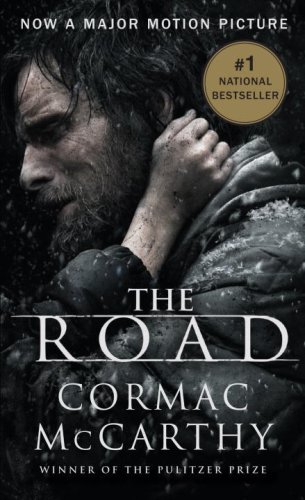
These are the essential elements of Cormac McCarthy's post-apocalyptic novel The Road, without doubt the most terrible, beautiful, miserable, punishing book I have ever read.

Because I care for my readers, I beg you to skip this book. The Road, a Pulitzer winner, has been called the best book of the last twenty-five years and the best book of the decade, but I call the reading of it masochistic. There is no levity. The anemic tendrils of hope are short-lived and emphatically dashed. Even the vast sections of tedium are laced with shivering omen.

Whatever McCarthy's grand intended message, it vanished like so much sugar in a ladleful of ipecac. This is no Diary of a Young Girl; this is exploitative horror from whole cloth masquerading as social commentary -- a literary Marilyn Manson album.

An Amazon Kindle looms large on my Christmas list this year. I know now I'd pay a hefty premium for an "Un-Read This Book" feature.

April 5, 2010

Also, "Scottéric Bastiat" Was Already Taken

Judging by the way several people -- upon making my personal acquaintance -- mispronounce the name of this blog, a bit of appellative exposition is in order.

The name "Scotticus Finch" is a barely-creative take on Atticus Finch, the protagonist in Harper Lee's 1960 masterpiece To Kill a Mockingbird. Finch was peerlessly portrayed in the 1962 film version by Gregory Peck, a performance that netted Peck an Oscar and (forty years later) cemented Finch as the greatest hero in 100 years of American cinema (edging out such icons as Superman, Indiana Jones, and James Bond).

Today, writing a progressive character who fights against racist ignorami is just lazy. In 1962, it was contemporary. In Mockingbird, Finch, a southern lawyer, represents a black man falsely accused of raping a white woman. The book is written from the perspective of Finch's young daughter, so some of the lessons aren't exactly groundbreaking -- "You never really understand a person until you consider things from his point of view - until you climb into his skin and walk around in it." -- but Finch was a practical idealist, a crack-shot pacifist, an eternally-patient single parent, and an anti-authoritarian agent of the state. We don't get heroes like that every day.

Finch on democracy: "The one thing that doesn't abide by majority rule is a person's conscience."

Bastiat himself couldn't have said it better.

Incidentally, today would have been Peck's 94th birthday.

April 2, 2010

Maybe One Day They Will Make a Book Version of the "Lord of the Rings" Movies

I spend an unhealthy amount of time thinking about exactly what I would wish for, given the opportunity. Much depends on the exact circumstances: Is it a standard three-wish genie situation? A four-wish monkey paw? Just one wish like Ray J? And what if it turns out I'm being taught an "important lesson", and everything I wish for turns out horribly wrong?

It's a lot to consider. A constant thread to the fantasy, though, is that one way or another, I would use my wish(es) to permanently remove a single phrase from the collective human lexicon:

"Yes, I saw the movie. The book was so much better."

That sentence has never been additive to any conversation in the history of human dialogue, and 9999 times out of 10,000 it could be replaced by saying "I'm fairly certain I'm intellectually superior to you" instead.

What exactly is the sentiment behind such a declaration? What was "better" about the book? Did our pretentious speaker deftly perceive that characters developed more over 400 pages of descriptive third-person narrative than in 100 pages (mostly white space and stage direction) of a script? Is it that sixteen paragraphs describing the feelings, thoughts, memories, smells, and history associated with a particular location provides a broader context than a five second establishing shot? What is the consistent set of measurable values through which this comparative assessment becomes valid?

Movies and books are such vastly different media that claiming Puzo's The Godfather is "better" than Coppola's The Godfather is as sensible as claiming Pope Benedict is better than eggs Benedict. (Never mind the fact that -- separately and independently -- Coppola's film is fantastic and Puzo's book is lousy.)

Most books cannot emotionally accomplish in two hours what movies can. And very few movies can envelop the consumer and create the kind of sensory investment that books can. Comparing them side-by-side demeans them both.

More unfortunate still, most people who make these claims don't even have a lukewarm basis for it in their own minds. Instead it serves as a way to boldly declare "I READ A BOOK!" in the middle of an entirely orthogonal conversation.

While we're all very proud of you for reading Marley and Me all the way through, your decision to hijack my conversation for the purposes of misplaced self-aggrandizement hath triggered my wrath.

Two wishes left. Maybe I'll wish for innocuous observations to stop making me so grumpy...